
EN This year’s Nobel Prize in Chemistry went to Susumu Kitagawa, Richard Robson, and Omar M. Yaghi. The scientists developed something that sounds quite technical – Metal-Organic Frameworks (MOFs).
But what exactly are they?
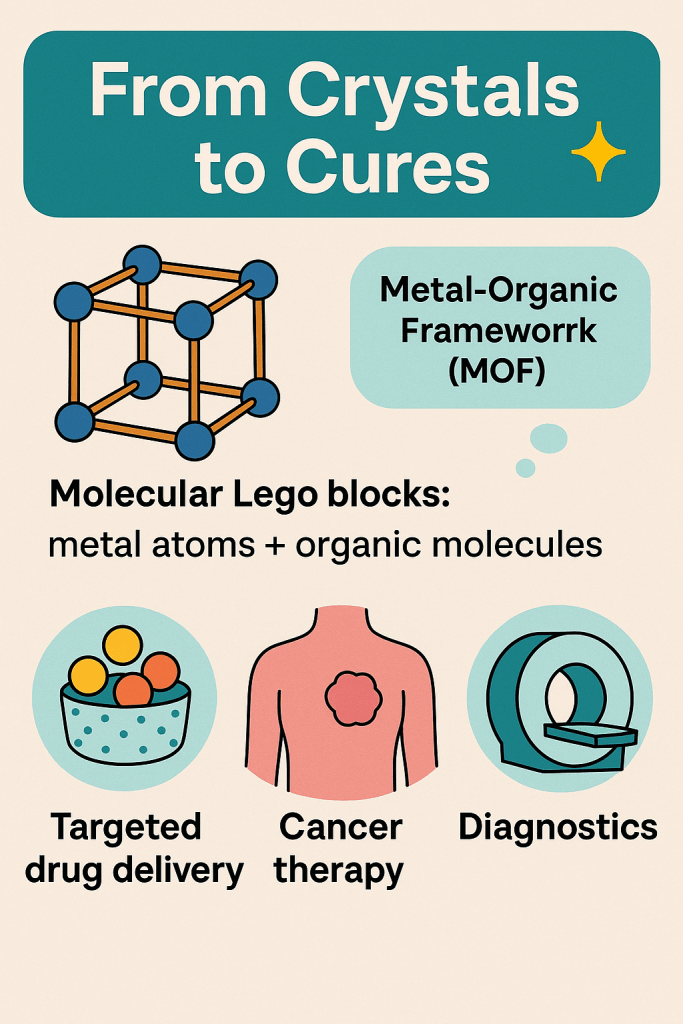
Think of them like molecular Lego blocks:
- metal atoms act as solid “cornerstones,”
- and long organic molecules are the connectors.
Together, they build crystals with enormous, regular empty spaces inside. These microscopic cavities make MOFs work like sponges on the atomic level.
Why is that important?
They can capture and store gases (like carbon dioxide or toxic substances) and even collect water from desert air.
And here’s the link to medicine – MOFs open up fascinating possibilities for healthcare:
- targeted drug delivery: medicines can be “packed” into MOFs and released exactly where they’re needed,
- cancer therapy: tested as carriers of anti-cancer drugs, potentially less toxic than classic chemotherapy,
- diagnostics: thanks to their magnetic properties, MOFs can be used as contrast agents in MRI scans,
- theranostics: combining therapy and diagnostics – carrying a drug while also allowing doctors to track its effects in real time.
It shows that the chemistry of tomorrow is not just about test tubes and reactions, but also about creating real tools for medicine and human health.
Interesting, right? Last year’s Chemistry Nobel went to scientists behind the AI model AlphaFold2 and the design of new proteins. This year, the prize reminds us that by rethinking the very building blocks of matter, we can change the way we fight disease.
PL Tegoroczna Nagroda Nobla w dziedzinie chemii trafiła do Susumu Kitagawy, Richarda Robsona i Omara M. Yaghiego. Naukowcy ci stworzyli coś, co brzmi dość technicznie – struktury metaloorganiczne (MOF, Metal-Organic Frameworks).
Co to takiego?
Można to sobie wyobrazić jak molekularne klocki Lego:
- atomy metali działają jak solidne „kamienie węgielne”,
- a długie cząsteczki organiczne są jak łączniki.
W efekcie powstają kryształy z ogromnymi, regularnymi pustymi przestrzeniami w środku. Te mikroskopijne „dziurki” sprawiają, że MOF-y działają jak gąbki na poziomie atomów.
Dlaczego to takie ważne?
Mogą pochłaniać i przechowywać gazy (np. dwutlenek węgla czy toksyczne substancje), a nawet zbierać wodę z powietrza na pustyni.
Ale co ciekawe – i tu łączy się chemia z medycyną – MOF-y otwierają nowe możliwości w leczeniu chorób:
- celowane dostarczanie leków: można „zapakować” w nie leki i uwalniać je dokładnie tam, gdzie trzeba,
- terapia raka: badane są jako nośniki leków przeciwnowotworowych, mniej toksycznych niż klasyczne chemoterapie,
- diagnostyka: dzięki właściwościom magnetycznym mogą służyć jako środki kontrastowe w rezonansie (MRI),
- teranostyka: czyli połączenie terapii i diagnostyki – lek i jednoczesne monitorowanie jego działania w jednym.
To pokazuje, że chemia przyszłości to nie tylko probówki i reakcje, ale także realne narzędzia dla medycyny i zdrowia ludzi.
Ciekawe, prawda? W zeszłym roku Nobel z chemii trafił do twórców sztucznej inteligencji AlphaFold2 i projektanta nowych białek – a teraz wracamy do podstawowej materii, ale w nowej formie, która może zmienić sposób, w jaki leczymy choroby.
 Exploring how voice connects music, science, and emotion.